What Are You Looking At?
And what it may be costing you.
Two weeks ago, I officiated a celebration of love ceremony.
As an ordained pastor, I have stood in front of couples at some of the most significant moments of their lives. But this ceremony was different. I asked the groomsmen to do something they had never been asked to do before.
Each one walked forward carrying a plank.
Real planks. Cut and finished. I had them made specifically for this moment.
One by one, each groomsman placed his plank down and offered the couple a single piece of advice about the next step they were about to take together. Not a toast. Not a speech. A piece of advice. About a step.
When they were done, the planks formed a path.
That path was the beginning of what I call the Bridge Paradigm.
The Bridge Paradigm is this.
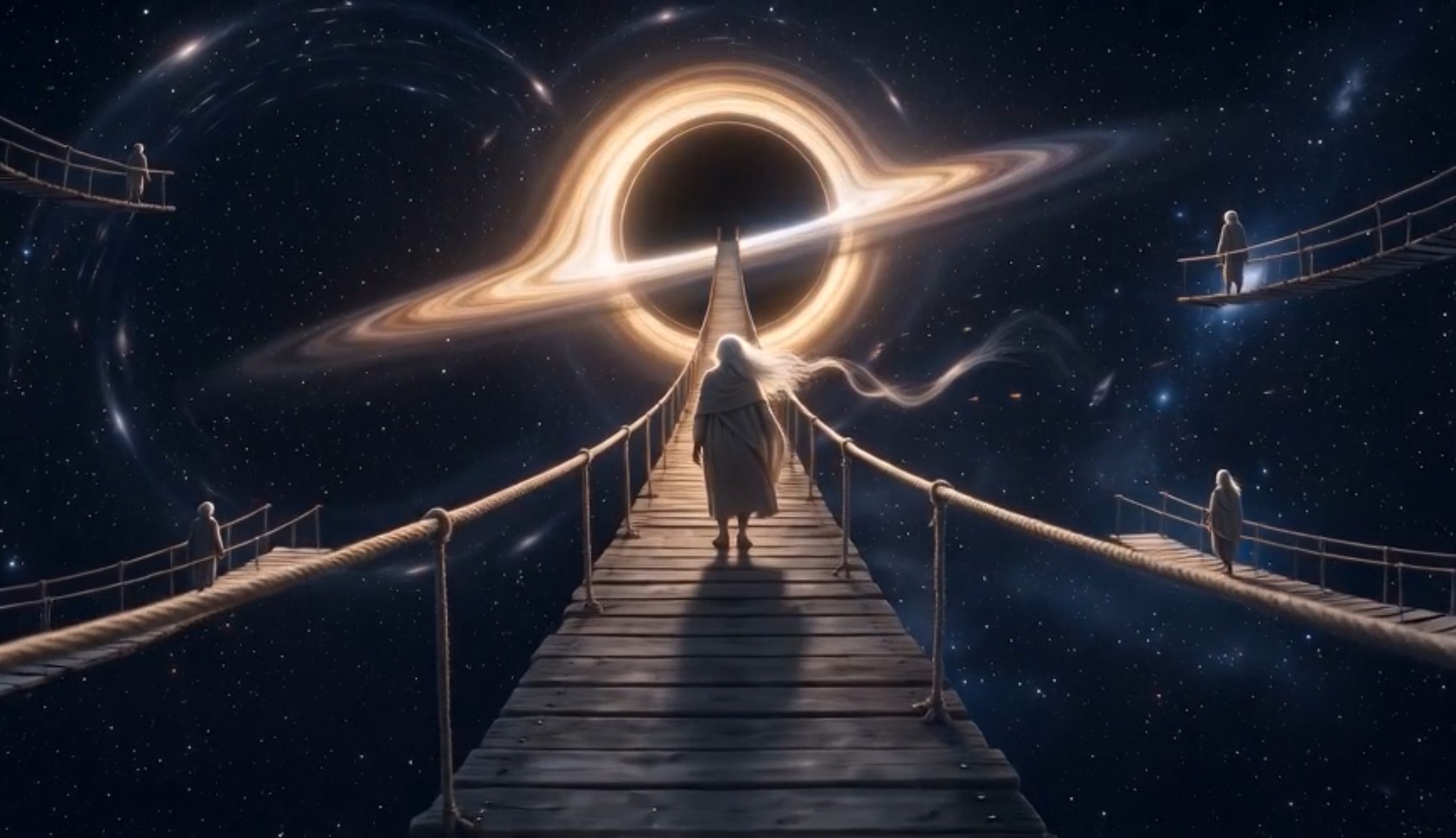
Your life is a rope bridge. Individual. Suspended. Built one plank at a time. Every decision you have ever made is a plank on that bridge. Not just the big ones. Every one of them. And no matter what your last decision was, the bridge requires another. The next plank does not wait for you to feel ready. It waits for you to step.
Everyone is crossing their own rope bridge.
Not the same bridge. Not a shared highway. A rope bridge. Individual. Built one plank at a time.
Each plank is built on your last decision. Not your best decision. Not your wisest decision. Your last one. And no matter what that last decision was, you still have to make another one.
This is true for every relationship you will ever have. Personal. Professional. The relationship you have with yourself. Every one of them is a bridge being built in real time, one decision at a time, by two people who started on completely different paths.
Here is where most couples make a mistake that costs them years.
They forget that their partner came from a different bridge.
I have heard it across coaching rooms for 25 years. One partner turns to the other and says: “I can’t believe you did that. I wasn’t raised that way.”
That statement does not give credit to the step-by-step, plank-by-plank individual journey the other person walked to get here. It does not account for the decisions they made, the gravity they carried, the bridge they built before this relationship ever began.
Research confirms what most of us experience but rarely name. Mismatched expectations serve as a substantial source of relationship conflict, creating a disconnect between partners that arises from different cultural backgrounds, upbringings, and personal experiences (Take Root Therapy, n.d.). Each partner comes to the journey with their own set of directions, including assumptions about roles, expectations about how to spend time and money, and deeply held beliefs (WebMD, n.d.).
That is not incompatibility. That is two bridges meeting.
The planks are in different places because different decisions were made. By different people. On a completely different path. Long before this relationship began.
Unmet expectations are strongly related to one’s upbringing, and it is common for couples to try to change each other in an attempt to make partners meet their needs or expectations (WebMD, n.d.). What that research does not say is this: the expectation was never about the partner. It was about the bridge the person came from. And demanding your partner’s bridge look like yours is not a relationship. It is a renovation project nobody agreed to.
Now here is where the bridge becomes something else entirely.
There are people who have turned around on their bridge.
Not stopped. Bridges do not stop. Time does not stop. You still age. You still have to live with yourself and the people around you. The planks keep being laid whether you are paying attention or not.
But there are people who turned around on their bridge and have not turned back. And while they face backward, feeding their energy into the past, the bridge keeps moving forward without them steering it. Decisions get made by default. Relationships get shaped by inertia. Life keeps being lived. Just not in the direction they would choose if they were paying attention.
The question is never whether your bridge is moving.
It is always: which direction are you facing?
And here is what I have observed after 25 years of watching people get stuck.
The past is a black hole.
I know this because I have watched it in my own family across four generations.
My grandmother is 94 years old. And she still talks about the adults from her childhood who did her great harm. Those adults were my great-grandparents. People who had incorporated the generational hurts from their own parents and passed them forward without examining them. Without choosing them. Without even knowing they were doing it.
I am in a somewhat unique position because I was also raised by those same great-grandparents. Same situations. Same household. Same people.
Different steps.
My grandmother and I came from the same bridge origin. We crossed paths with the same darkness. But we made different decisions about which direction to face. And those decisions, made at different moments by two different people on the same bridge, produced two completely different lives.
My grandmother is still captured by the gravitational pull of lamenting what was done to her. The bridge has kept moving. She has kept aging. The people who harmed her are long gone. And the black hole is still pulling.
That is not weakness. I want to say that clearly. That is the nature of a black hole that was installed before she had the language to name it or the tools to face it.
But the bridge never stopped.
It never stops.
Time did not pause while she faced backward. Life kept accumulating around her. The people who love her kept needing her presence. And the energy she pours into the past is energy that does not come back.
A black hole, by its nature, has gravity. The longer you stand near it, the stronger the pull becomes. Chronic regret keeps your body’s stress response switched on. Your brain does not distinguish between reliving a painful memory and experiencing a new threat, so each time you revisit that regret, your system floods with cortisol and adrenaline (Reachlink, 2024).
Black holes are never satisfied.
No matter how much of your time you pour in, no matter how much of your attention you feed it, no matter how much of your energy you sacrifice to it — the black hole is not satisfied. It is not grateful. It does not close. It does not heal. It does not produce a single new plank.
It just pulls.
Rumination consists of a repetitive stream of negative thoughts or themes, often involving mentally replaying a past scenario or conversation. Rumination can damage mental and physical health, increasing the risk of depression, anxiety, insomnia, and inflammation (Harvard Health Publishing, 2020). The research calls it rumination. I call it feeding the black hole. Either way, the effect is the same: this pattern magnifies negative mood, impairs concentration, and reduces motivation to engage in activities that might actually help (Superpower, 2024).
And someone you know is standing on their bridge right now, facing backward, feeding the black hole.
Maybe that person is you.
I want to be clear about something.
Looking backwards is not the problem. It is necessary. It is natural. Every person on every bridge turns around from time to time. That is not weakness. That is wisdom operating correctly. The past is supposed to inform the present. That is its job.
And I did not walk my own path without getting stuck.
I have made mistakes in my decisions. Some due to my programming. Some due to ignorance. Some due to my own stupidity. I will not dress that up into something more flattering than it is.
Some of those decisions will haunt me for the rest of my life. Some of them will bother me for the rest of my journey. I have made peace with that. Not because the mistakes do not matter, but because hating myself for being human has never once produced a new plank.
What changed was not that I stopped carrying the past.
What changed was that I stopped facing it.
Once I turned forward, I gave myself the chance to make different decisions. The past did not disappear. It came with me. But now it was behind me, informing my next step, instead of in front of me, consuming it.
It did not happen with one plank. One decision does not change a life. It takes a thousand decisions. Every single day. Some of them small. Some of them enormous. But every one of them is a step in a direction I am choosing.
I would rather move forward with purpose and intent than continue to hate myself for being human.
That is not a philosophy. That is a decision.
And it is the next plank.
The Muck in the 4 Armies Method is not just a metaphor for being stuck.
It is the lived experience of a person whose bridge has been consumed by the gravity of their own past. The thick, viscous pull of inherited patterns, old wounds, and unexamined decisions. The suction that increases the harder you try to move while still facing backward.
The Fourth Army — The Muckers — are not weak people. They are people who turned around on the bridge one time too many, and the black hole found them before they could turn back.
And in relationships, two people’s black holes do not cancel each other out. They interact. The gravity of one partner’s past pulls at the other. Two people navigating the same relationship are often navigating the gravitational fields of two separate pasts, without knowing it.
That is why “I wasn’t raised that way” is the most expensive sentence in any relationship. It is not a complaint. It is a collision of two black holes, both of them pulling, neither of them named.
Back to the ceremony.
When I asked the groomsmen to lay their planks, I was not just creating a visual. I was installing an instruction.
Every decision you make together is a plank. Every conversation you have with honesty is a plank. Every time you choose connection over being correct, you lay a plank. Every time you turn toward your partner instead of toward the black hole of an old argument, you lay a plank.
And when two people connect their bridges, they are not merging into one path. They are learning to walk side by side on two bridges that were built differently, by two people who came from completely different places. And that is not a problem to solve.
That is the point.
Couples from different backgrounds thrive when proactively addressing areas of conflict and cultivating mutuality (Psychology Today, 2024). The research uses the word mutuality. I would translate that as this: respecting that your partner’s bridge was built the way it was built for reasons you did not witness and may never fully understand.
The goal is not to rebuild their bridge.
The goal is to keep laying planks on yours. And to turn around, face forward, long enough to reach back and help them lay theirs.
That is the Catcher. That is the Second Army at its best.
You have a bridge.
It was built on every decision you have ever made. The good ones and the ones you would do differently. Every plank matters. Even the crooked ones. Even the ones that felt like mistakes at the time.
What you do next is the next plank.
And the black hole behind you?
It will always be there. It will always pull. That is its nature.
Your job is not to fill it.
Your job is to keep building forward.
activeconnectivity.com
calendly.com/activeconnectivity/15min
References
Harvard Health Publishing. (2020). Break the cycle: The circular thinking that characterizes rumination can harm your health. Harvard Women’s Health Watch. health.harvard.edu/mind-and-mood/break-the-cycle
Heckhausen, H., and Gollwitzer, P.M. (1987). Thought contents and cognitive functioning in motivational versus volitional states of mind. Motivation and Emotion, 11(2), 101-120.
Psychology Today. (2024, January). Building a successful intercultural marriage and family. psychologytoday.com
Reachlink. (2024). What regret does to mental health and how to heal. reachlink.com/advice/guilt/what-regret-does-to-mental-health
Superpower. (2024). Rumination: Why your brain gets stuck and how to break the cycle. superpower.com/guides/rumination-why-your-brain-gets-stuck-and-how-to-break-the-cycle
Take Root Therapy. (n.d.). How do we stop having the same fight over and over? losangelesmftherapist.com
Tversky, A., and Kahneman, D. (1992). Advances in prospect theory: Cumulative representation of uncertainty. Journal of Risk and Uncertainty, 5(4), 297-323.
WebMD. (n.d.). Newlyweds’ biggest pitfalls. webmd.com
The Bridge Paradigm is original IP of RK Springfield, Active Connectivity. First written expression: October 6, 2026. No prior existence as a named framework confirmed as of October 2026. All rights reserved.